Featured
"Why Community Is Shameful" and More Lies Things To Know ...
Certified Guidance Preserves Your Home Things To Know Bef...
An Unbiased View of How Waiting Your Debt Problems Makes ...

Some Known Details About What to Watch For While Selectin...

Certified Guidance Preserves Your Home Things To Know Before You Get This
Table of Contents
The counselor will certainly examine your funds with you to identify if the program is the right alternative. The testimonial will certainly include a take a look at your regular monthly revenue and expenses. The company will certainly draw a credit score report to comprehend what you owe and the degree of your difficulty. If the forgiveness program is the most effective remedy, the therapist will certainly send you an arrangement that information the strategy, including the amount of the monthly settlement.
If you miss out on a payment, the arrangement is squashed, and you have to exit the program. If you believe it's a great choice for you, call a therapist at a not-for-profit debt therapy company like InCharge Debt Solutions, that can address your questions and assist you determine if you qualify.
Due to the fact that the program allows debtors to opt for less than what they owe, the creditors who take part want reassurance that those that make the most of it would certainly not have the ability to pay the total. Your bank card accounts likewise should be from financial institutions and credit report card companies that have actually consented to get involved.
Balance has to go to the very least $1,000.Agreed-the equilibrium should be paid off in 36 months. There are no expansions. If you miss out on a payment that's simply one missed out on settlement the agreement is terminated. Your creditor(s) will terminate the plan and your balance goes back to the initial quantity, minus what you've paid while in the program.
How to Contact APFSC with the The 12 Most Common Myths About Debt Relief—Busted by Real Counselors : APFSC Journey Can Be Fun For Everyone
With the forgiveness program, the lender can instead choose to maintain your financial obligation on guides and redeem 50%-60% of what they are owed. Nonprofit Bank Card Financial debt Mercy and for-profit financial debt negotiation are comparable because they both offer a method to work out bank card debt by paying much less than what is owed.
Charge card mercy is created to set you back the customer less, settle the financial debt quicker, and have fewer downsides than its for-profit equivalent. Some crucial locations of difference between Credit Card Debt Forgiveness and for-profit debt negotiation are: Credit rating Card Debt Forgiveness programs have partnerships with lenders who have accepted get involved.
Once they do, the benefit period starts immediately. For-profit financial obligation settlement programs work out with each creditor, typically over a 2-3-year period, while passion, costs and calls from debt enthusiasts proceed. This suggests a bigger hit on your debt report and credit rating, and an enhancing equilibrium until arrangement is completed.
Credit Card Debt Mercy clients make 36 equal monthly settlements to eliminate their financial obligation. The repayments most likely to the financial institutions up until the agreed-to balance is removed. No rate of interest is billed during that period. For-profit financial debt settlement customers pay right into an escrow account over a settlement duration towards a swelling amount that will certainly be paid to financial institutions.
The No-Cost Online The 12 Most Common Myths About Debt Relief—Busted by Real Counselors : APFSC Resources Offered by APFSC Statements
/images/2025/11/17/how_does_debt_settlement_work_.png)
During this moment, costs might boost, and rate of interest accrues, so repayments might wind up not being budget-friendly for customers. On the other hand, customers stop making repayments to their bank card accounts. Calls from debt collectors proceed and creditor-reported non-payments remain to harm the client's credit scores record. Registration in a Charge Card Financial debt Forgiveness quits calls and letters from debt collection and healing agencies for the accounts consisted of in the program.
For-profit financial debt negotiation programs do not quit collection actions until the lump-sum settlement is made to the financial institution. Nonprofit Bank Card Financial obligation Forgiveness programs will inform you in advance what the monthly fee is, capped at $75, or much less, relying on what state you reside in. For-profit financial obligation settlement companies might not be clear about charge quantities, which commonly are a percent of the balance.
Some Known Questions About How to Never Fall Into New Debt Problems After Debt Relief.
For-profit financial debt negotiation likely will injure it much more, given that you won't be paying creditors during the 2-3 year negotiation/escrow duration, however they have not consented to a plan or received any cash, so they're still reporting nonpayment. This is on top of the credit history struck from not paying the total.
In many cases, financial obligation loan consolidation also features a reduced passion price than what you were paying on your charge card, making the regular monthly expenses, along with general expenses, less. Charge card financial obligation loan consolidation's most usual forms are financial debt management strategies, financial debt combination financings, or a zero-interest transfer credit history card.
To get a financial debt consolidation lending or a zero-interest equilibrium transfer bank card, you require a credit rating of at the very least 680. Greater. If your accounts are billed off, your credit rating is likely well below that. Credit report isn't an aspect for financial debt monitoring program, however you require an enough revenue to be able to make a regular monthly repayment that will certainly cover every one of the accounts consisted of in the program.
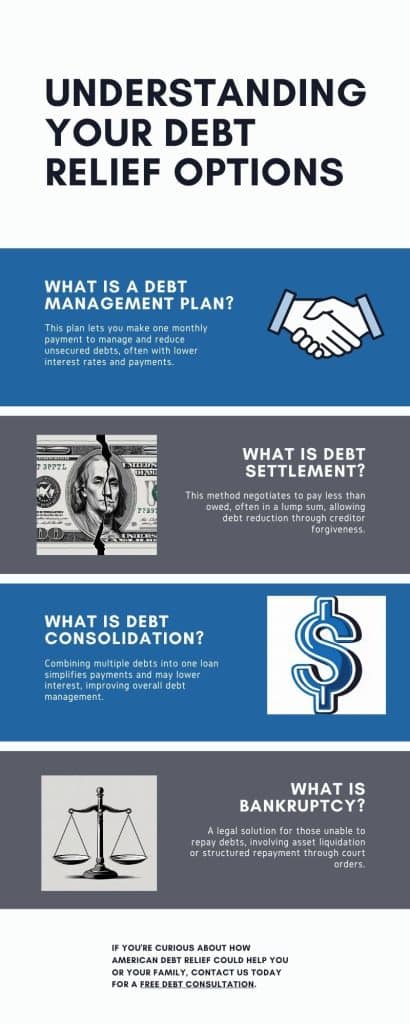
Bankruptcy is the last option for someone who has more debt than they can pay. Nonprofit Bank Card Debt Mercy will not remove virtually as much financial debt as bankruptcy does, but it additionally has much less of the lasting adverse financial effect insolvency carries. It can be the step you absorb order to prevent bankruptcy.
The Ultimate Guide To Comparing Debt Forgiveness Options to Find the Right Match
Bankruptcy will get rid of all qualified unsafe debt. Credit History Card Financial obligation Mercy will have an unfavorable impact on your credit rating given that complete balances on accounts were not paid.
Charge Card Debt Mercy repayments begin as quickly as you're accepted right into the program. Personal bankruptcy authorization and discharge can take 6-12 months. Collection activities and lawsuits on Charge card Debt Mercy clients are stopped once creditors consent to the strategy. Declare insolvency causes an automated remain on collection activities and lawsuits, and provides protection from harassment by lenders, but if the court does not authorize the personal bankruptcy, those will launch once more.

Table of Contents
Latest Posts

"Why Community Is Shameful" and More Lies Things To Know Before You Buy
Certified Guidance Preserves Your Home Things To Know Before You Get This
An Unbiased View of How Waiting Your Debt Problems Makes Things Worse
More
Latest Posts
"Why Community Is Shameful" and More Lies Things To Know Before You Buy
Certified Guidance Preserves Your Home Things To Know Before You Get This
An Unbiased View of How Waiting Your Debt Problems Makes Things Worse